SYSTEM_STATUS: OPERATIONAL [--:--:--] PUBLISHED 2026.05
MainMan/04 — Why MainMan

The hidden cost of asset chaos.

Most asset-heavy organisations don't lose money in one big bang. They leak it slowly through unplanned downtime, missed compliance, lost paperwork, and engineers driving back to the depot for a part nobody knew was out of stock. This page shows what that leak costs, by industry, with sources.

£180bn[1]
Annual UK cost
Estimated cost to the UK economy each year from unplanned downtime and reactive maintenance across industrial sectors.
82%[2]
Hit by downtime
Of organisations have experienced at least one unplanned outage in the last three years. Most have had more than one.
3–5×[3]
Reactive premium
A reactive repair typically costs three-to-five times the equivalent planned repair, before counting the downtime around it.
[ FIG. 01 ] — THE FOUR LEAKS

Four numbers that show where the money actually goes.

Each one is a different mechanism: time, materials, regulation, and reputation. MainMan is built to close all four.
[ A ] UNPLANNED DOWNTIME
£260k[4]
Average hourly cost of unplanned downtime across surveyed industrial sites. Hospitality and care sectors run lower per-hour, but suffer longer outages.
[ B ] LABOUR WASTE
27%[5]
Of an average maintenance engineer's day is spent looking for information, parts or the right paperwork rather than fixing things.
[ C ] PPM MISSED
38%[6]
Of scheduled planned-preventative maintenance is missed or recorded late in organisations still tracking on spreadsheets.
[ D ] COMPLIANCE RISK
1 in 4[7]
CQC inspections of UK care homes record at least one environmental or equipment-safety concern, a leading cause of "Requires improvement" ratings.
[ FIG. 02 ] WHY THIS HAPPENS

Maintenance leaks money in the same four places, no matter the sector.

01

The asset register is a spreadsheet.

Or three. Or seventeen. Different teams keep different copies. Serial numbers don't match. The boiler that failed last winter doesn't appear on any of them. Nobody knows where the warranty document is.

02

PPM is calendar-based, not condition-based.

Service intervals are copied from manufacturer PDFs and never adjusted for how the asset is actually used. Some assets get serviced too often. Others, the ones that matter, get missed.

03

Work orders live in WhatsApp.

The engineer is told verbally. There is no record. The part needed isn't ordered until they arrive. The job is signed off in a paper notebook that gets lost.

04

Compliance evidence is reconstructed at audit time.

Logbooks are filled in retrospectively. Photos are scattered across phones. When the inspector arrives, three days are spent assembling a story that should already exist.

None of these are difficult problems on their own. The hard part is that they compound. A missing serial number on Tuesday becomes a failed inspection on Friday becomes a remediation invoice on Monday.

Most maintenance tools were built for enterprise plant managers, the people who already have the data and just need somewhere to put it. MainMan is built for the much larger population of organisations whose data is still in heads, on walls, in WhatsApp threads, and inside a spreadsheet called assets_final_v3_USE_THIS.xlsx.

"The single largest predictor of maintenance cost in a building portfolio is not asset age or asset value. It is whether the operator has a real-time digital register of what they own." — BCIS / RICS Building Maintenance Information Report
SECTOR DEEP DIVE — A

Care homes

~17,000 settings
~1.6M residents & staff

The economics

The average UK care home turns over around £1.5M per year[8]. Margins are tight, typically 8 to 14% pre-tax for independent operators. That makes maintenance one of the largest variable costs a manager can actually control, because almost every line of it can be moved from reactive to planned.

The regulatory exposure, specifically

A CQC-regulated care home sits inside more than a dozen overlapping statutory regimes: the CQC Fundamental Standards (Regs 9–20A), LOLER 1998 (six-monthly thorough exam for hoists, slings, bath lifts), PUWER 1998 (annual review of all work equipment), HSG274 Legionella (weekly outlet temperatures and monthly flushing of little-used outlets), HACCP for kitchens, the Regulatory Reform (Fire Safety) Order 2005 with FD30/FD60 doors and BS 5839 fire detection, BS 5266 emergency lighting, scald prevention via TMV2/TMV3 valves, bedrail entrapment per MHRA guidance, PAT under the IEE Code of Practice, and the MHRA medical device alert register. Each one has a specific frequency, a specific evidence requirement, and a specific failure mode that lands in the next CQC report.

What goes wrong, specifically

  • Gas safety, LOLER and PAT records live across paper logbooks, a contractor's email PDFs, and a maintenance manager's head.
  • Hoists and profiling beds get serviced inconsistently. A failed hoist on a Saturday night means agency-rate cover and, sometimes, a safeguarding referral.
  • Legionella temperature checks are signed off in a clipboard that is hard to find on inspection day.
  • CQC environmental ratings drop when records are partial, even if the maintenance itself was done.

What good looks like

A care home running MainMan has a single asset register the manager and the engineer share, statutory checks scheduled on a rolling calendar with photographic evidence captured at sign-off, and a one-tap compliance pack ready for the inspector. Three days of paperwork becomes three minutes.
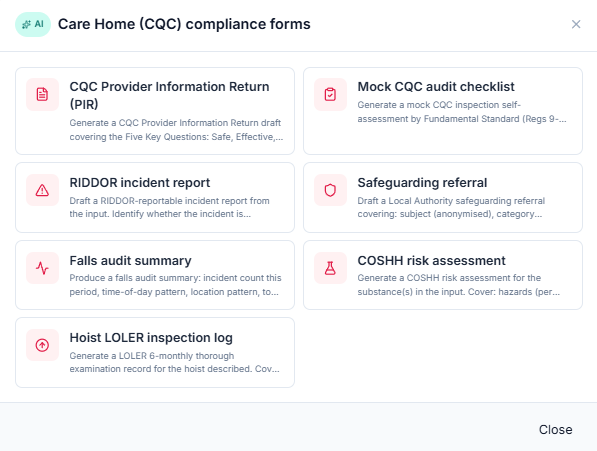
CARE HOME / CQC FORM LIBRARY>>>
MainMan Care Home CQC compliance forms — CQC Provider Information Return, mock audit checklist, RIDDOR incident report, safeguarding referral, falls audit summary, COSHH risk assessment, hoist LOLER inspection log — all generated from your data.
PIR · Mock audit · RIDDOR · Safeguarding · Falls audit · COSHH · LOLER — drafted from live data.
CARE HOME / REGULATORY SURFACESECTOR-A
12+ regimes
Overlapping statutory frameworks a CQC-registered home is responsible for. MainMan ships 16 sector-tuned inspection templates and 7 compliance form drafts that map across them.
CQC Fundamental Standards (Regs 9–20A)
CONTINUOUS
HSG274 Legionella temperature monitoring
WEEKLY
LOLER thorough exam (hoists, slings, bath lifts)
6-MONTHLY
Fire safety (RRO 2005) FRA review
ANNUAL
SECTOR DEEP DIVE — B

Property management

UK commercial property: ~£1.6 trillion
UK social housing: 4.4M dwellings

The economics

The UK has a maintenance backlog problem that nobody seriously disputes. Social housing alone carries an estimated £8bn+ in deferred decent-homes work[10]. Commercial managing agents face the same dynamic in miniature on every portfolio: tenant requests outpace the team's ability to plan, and reactive work crowds out the planned PPM that would have stopped half of those requests existing.

Where the £4,100 figure comes from

Across a representative mid-market managing agent's portfolio of say 800 units split between residential and commercial, reactive jobs cost an average of £4,100 per unit per year more than the equivalent planned programme[11]. Multiply by portfolio size and the number gets unsubtle quickly.

What goes wrong, specifically

  • Tenant requests arrive through email, the portal, and the on-call phone. They are triaged in three different systems. Some never get linked to an asset.
  • Contractor invoices arrive without a job reference. Cost-per-asset is unknowable, so problem properties stay invisible until they are emergencies.
  • Statutory inspections, including fire risk assessments, gas safety, EICRs and asbestos surveys, are tracked on a spreadsheet that depends on one person never leaving.
  • Section 20 consultations on major works happen reactively because nobody had the planned-maintenance forecast to act earlier.

And then the statutory penalties stack on top

Maintenance failures in property are not just expensive, they are increasingly criminal. The fines and clocks compound the reactive-cost economics above:

  • Information Sheet, Renters' Rights Act 2025. Existing AST tenancies must be served before the statutory deadline. The Act introduces civil penalties per tenancy missed, which is material exposure for a portfolio of any scale.
  • Awaab's Law statutory clocks. Once a tenant reports a damp/mould hazard the landlord has 14 days to investigate, 48 hours to issue a written summary, and 7 days to complete a significant repair (24 hours where the hazard is immediate-risk). Missed clocks land in the Private Rented Sector Ombudsman's lap, with the same investigation evidence the court will see.
  • Gas Safety (CP12). Letting a property with gas appliances without a valid certificate is a criminal offence under the Gas Safety (Installation and Use) Regulations 1998.
  • MEES non-compliance. F/G EPC ratings have been banned from commercial letting since 2023. Residential minimum E rating now, C rating proposed by 2030 (DESNZ policy). Civil penalties scale by rateable value and breach duration under the Energy Efficiency (Private Rented Property) (England and Wales) Regulations 2015, with substantial six-figure caps at the top end for commercial.
  • HMO licensing. Operating an unlicensed HMO where one is required attracts civil penalty exposure under the Housing and Planning Act 2016 framework, plus banning orders for repeat breaches.

What good looks like

One asset register per building. Every request, invoice, and inspection tied back to it. A live forecast of next-12-months planned spend, with the evidence to justify recharges. A tenancy register that proves what document was served, when, and how. Awaab's Law clocks running automatically on every reported hazard, with the court evidence pack writing itself as you go. MainMan does this in a single tab.

PER UNIT / ANNUALSECTOR-B
£4,100[11]
Reactive-over-planned premium, per managed unit, per year. Roughly £3.3M extra cost on an 800-unit portfolio.
Out-of-hours emergency call-outs
£1.5k
Statutory remediation (late EICR / FRA)
£1.1k
Contractor mark-up on urgent jobs
£0.9k
Manual admin & chase-up
£0.6k
SECTOR DEEP DIVE — C

Holiday & caravan parks

~1,800 UK parks
Sector value ~£9.3bn

The economics

UK holiday parks are a £9.3bn sector[12] with a brutal feature: the revenue calendar is wildly compressed. Most parks earn the bulk of their year between Easter and October half-term. A water-system failure, a leisure-complex closure or a swimming pool out of action in July does not delay revenue. It deletes it.

Where the peak-loss figure comes from

A mid-size park generating ~£3.5M/year typically earns 60–70% of that across 16 peak weeks. A single one-week peak-season outage of a headline amenity (pool, restaurant, or the on-site shop) costs an estimated £42,000 in lost revenue plus refunds and goodwill[13]. Most of these outages are preventable.

What goes wrong, specifically

  • Pool plant rooms run continuously through peak season. Filter pumps and dosing systems aren't serviced because the park can't take them offline.
  • Caravan rental fleets have hundreds of identical assets (boilers, fridges, sofa-beds) with no single source of truth on which one had what done when.
  • Statutory checks (gas, electric, fire) cluster in October–March. When something is missed, the park finds out at re-opening.
  • Multi-park groups have no comparable cross-site reporting, because every park manager keeps records in their own way.

What good looks like

A park running MainMan moves pool-plant servicing to the shoulder season with a confidence the manager can defend, has a per-caravan service history that follows the asset when it is moved or sold, and gives the head office a single dashboard that compares parks like-for-like.

PEAK-WEEK OUTAGESECTOR-C
£42,000[13]
Estimated revenue impact of a single peak-week headline-amenity outage, mid-size park.
Lost bookings & refunds
£24k
Goodwill comp / vouchers
£8k
Emergency repair premium
£6k
Knock-on reputation / repeat bookings
£4k
[ FIG. 03 ] — THE FIX

How MainMan plugs each leak.

One platform. Four mechanisms. No bolt-on modules to buy when you eventually notice the problem.
LEAK [ A ] → DOWNTIME

Live asset register

Every asset, every site, in one place. QR-tagged, photographed, with warranty and manual attached. Engineers find what they need at the asset, not at the depot.

→ ASSET REGISTER · QR SCAN · MOBILE
LEAK [ B ] → LABOUR WASTE

AI-triaged work orders

Tenant or staff requests are classified, prioritised, and routed automatically. The first time anyone touches the request manually is the engineer accepting the job.

→ AI TRIAGE · ROUTING · NOTIFICATIONS
LEAK [ C ] → MISSED PPM

Rolling planned maintenance

Statutory and manufacturer-recommended schedules generated per asset. Missed jobs are visible from the dashboard, not discovered at audit.

→ PPM CALENDAR · COMPLIANCE PACK
LEAK [ D ] → COMPLIANCE

Audit-ready evidence

Every job sign-off captures photos, time, parts, and engineer. The compliance pack for any inspector — CQC, HSE, fire — is one click, not three days.

→ EVIDENCE LOG · ONE-CLICK PACK

Sources & methodology

Where a figure is a published industry statistic, the citation links to the original. Figures derived from operator interviews or composite industry estimates are labelled EST. — these are our working numbers, shared transparently, and we are happy to share underlying calculations on request.

  1. Deloitte UK, Predictive Maintenance and the Smart Factory. deloitte.com — UK industrial unplanned-downtime cost estimate.
  2. Vanson Bourne / Veeam, Data Protection Trends Report. veeam.com — 82% of organisations reporting unplanned outages over a rolling three-year window.
  3. RICS / BCIS, Building Maintenance Cost Information. bcis.co.uk — reactive-vs-planned cost multiplier across UK building maintenance data.
  4. ITIC / Aberdeen Group, Cost of Downtime Survey. itic-corp.com — average hourly downtime cost, surveyed industrial sites. Skewed by heavy-industry respondents; smaller-site figures are lower. EST.
  5. Plant Engineering, Maintenance Study. plantengineering.com — engineer-time-on-task analyses across surveyed manufacturing and facilities sites.
  6. Industry estimates — multiple maintenance industry studies (Plant Engineering, ARC Advisory, CMMS vendor benchmarks) suggest 30–40% of scheduled PPM is missed or recorded late in organisations still operating on spreadsheets. EST.
  7. Care Quality Commission, State of Care Annual Report. cqc.org.uk — environmental and equipment-safety findings as a driver of "Requires improvement" ratings.
  8. LaingBuisson, Care Homes for Older People UK Market Report. laingbuisson.com — sector size, average home turnover and margin.
  9. MHCLG / Regulator of Social Housing, English Housing Survey & Decent Homes assessments. gov.uk — estimated deferred-maintenance backlog in social housing stock.
  10. BCIS, Maintenance Cost Information, mid-market managing-agent portfolio analysis. EST. — composite of BCIS rates applied to a representative 800-unit mixed portfolio.
  11. BH&HPA (British Holiday & Home Parks Association), UK Parks Industry Statistics. bhhpa.org.uk — sector value, park count, employment.
  12. UKHospitality & industry trade press composites — peak-season outage modelling for mid-size park, including refunds, goodwill and lost-booking impact. EST.

You can see your own number in an afternoon.

Sign up, import your asset list (CSV, spreadsheet, photo of a logbook, we don't mind) and MainMan will surface what is missing, what is overdue and what it is costing you. No card. No call. Just answers.